Run  Qwen
Qwen
on your own machine
Any open-weight or custom model on your own hardware, with an OpenAI-compatible URL any app can use. No Docker, Python or GPU knowledge required — and nothing you send ever leaves your machine.
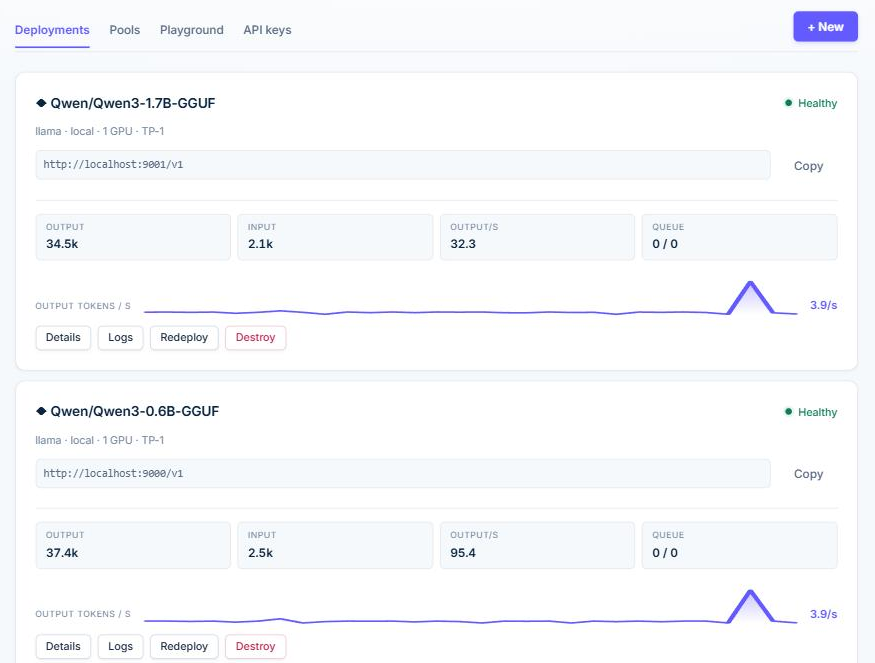
Deploy in one click
Pick a model, click Deploy, and get a link any OpenAI-compatible app can use. The platform decides the runtime, ports and GPU for you.
One command setup
One line in the terminal and it is running. The Python environment, the llama.cpp binary and the GPU setup come with it, hidden.
GPU detected for you
NVIDIA GPU with Docker runs vLLM; a GPU without it runs llama.cpp on CUDA; anything else runs on the CPU. It also sizes the model to the VRAM you have, and lets you pick the GGUF quantization by name.
Router across models
Create a pool of 2+ models and the router picks the best one per message. Judge escalation, rule-based routing and round-robin included.
How it works
Create your account
Email and password, stored locally in your machine.
Pick a model
Qwen, DeepSeek, Mistral, Muse-Glimmer or Bonsai from the catalog — or paste any Hugging Face model, down to the exact GGUF file.
Deploy and use
Your deployment gets a URL and ready-made Python, JS and curl snippets.
Runs on your hardware
Models stay on your machine. No cloud API, no token metering, no data leaving your machine.
vLLM
High-throughput inference on NVIDIA GPUs with Docker. Prefix caching enabled by default.
llama.cpp
GGUF models on any machine, vision models included, and a model bigger than your VRAM is split between GPU and CPU instead of refusing to start.
Your other computers, in the same dashboard
SursumAI Pro is the same app, unlocked by an account — nothing to reinstall and nothing else to learn.
Subscribe and copy a token
Click Go Pro, sign in with GitHub, subscribe, create a token.
Paste it in your dashboard
The Machines tab appears at once — no new download, no restart.
Add a server by its SSH line
Paste what your provider shows you. SursumAI installs itself there, opens a private tunnel and the models on it join your pools and your API.
Does the router actually work?
We measured it: 100 GSM8K maths problems on a single 6 GB NVIDIA GPU, every answer checked against the right number — no LLM grading another.
| Setup | Correct | Time per message |
|---|---|---|
| Qwen3-0.6B alone | 69% | 12 s |
| Router 0.6B + 8B, 1.7B judge | 87% | 39 s |
| Qwen3-8B alone | 93% | 107 s |
The router pays when the strong model is far more expensive than the cheap one; with a 0.6B + 1.7B pool it saved nothing. Times assume every model stays loaded. Method, raw data and what didn’t work →
Pricing
Everything on your own machine is free, forever. Pro is a subscription for running models on the servers you already have.
Free
- Unlimited models on your machine
- Router, pools and playground
- OpenAI-compatible API with account keys
- GPU detected and used automatically
- Open source (MIT)
- Community support on GitHub
Pro Beta
- Everything in Free
- Deploy to your own servers over SSH — unlimited machines
- Same install, unlocked by a token — nothing to reinstall
- One dashboard and one API for the models on all of them
- Nothing exposed on those machines: a private SSH tunnel
- Email support
- Cancel anytime — Pro keeps working until the end of what you paid
No per-user or per-token pricing: your models run on your hardware, and your prompts never pass through us.
Install in one command
Runs on Linux, macOS and WSL (Windows — open Ubuntu, not PowerShell). No Docker, Python or GPU knowledge needed. The same command installs Free and Pro.
Run sursumai and it opens http://localhost:3000 — create your account there and deploy your first model. sursumai update upgrades it, sursumai uninstall removes it.
Your models. Your machine. Your URL.
Deploy your first self-hosted model in one command.
Install free